Did you know that Cheese in France is very regional?
What I mean by that is that each type of cheese comes from a particular region. I just wrote a post about Camembert for example. Camembert is from the Normandie region. Camembert is not just a French cheese it is a French Normandie cheese.
I have a lovely serving plate for cheese which shows the cheeses of the different regions.
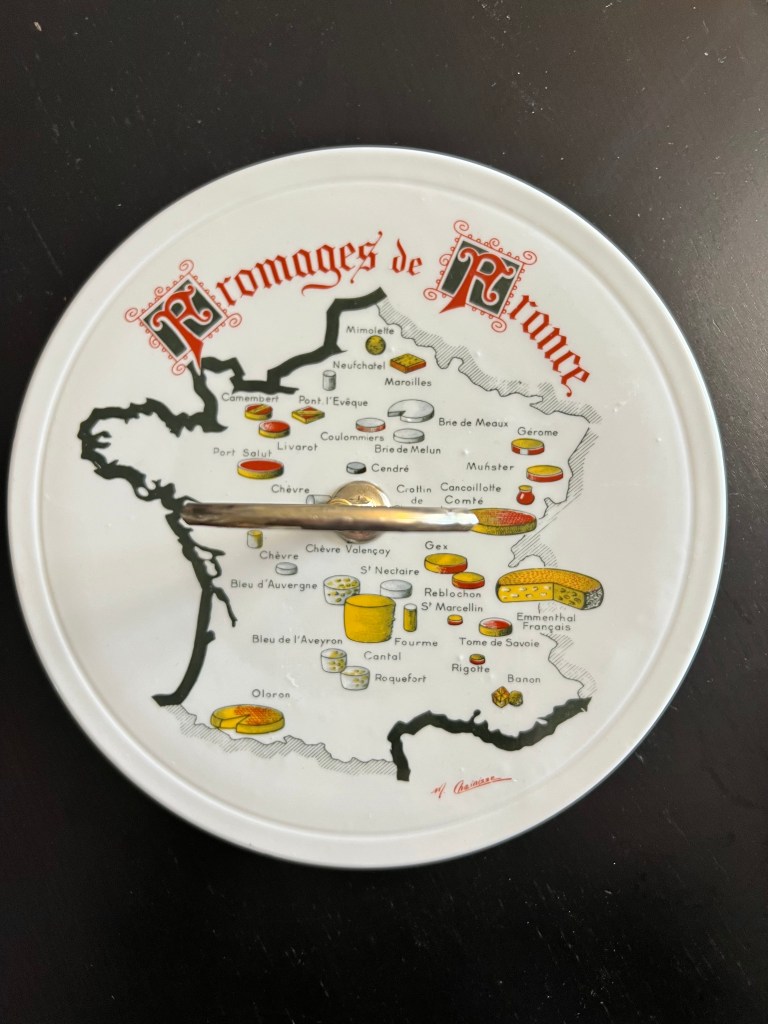
So for example, the blue cheeses, Roquefort, Bleu d’Auvergne, Bleu d’Aveyron tend to come from the middle south of France. Also, perhaps not surprisingly, there is a town called Roquefort in that region. The Bleu D’Auvergne as its name says, comes from the Auvergne region of France.
It is interesting to see the patterns…
Hard cheeses like Tome, Emmenthal and Comté come from the Alps. The blues as I noted from the middle south. The softer cheeses with a rind like Camembert, Pont L’Eveque, Livarot and Brie from the North and North-West (Normandie). Finally, the chevre cheese, the goat cheeses from the middle of France.
By the way, each cheese has its own “fungi” which turns the milk (whether goat, ewe, or cow’s milk) into the rind for the cheeses of the north or the “blue” of the cheese for the cheeses of the middle south and is crucial in giving each cheese its distinctive flavor. Camembert has Penicillium camemberti for example.
There is a fascinating story of the “cheese nun”. Her name is Noella Marcellino, she is a nun, and she undertook and completed a Ph.D. in microbiology studying the fungi of cheese in France. According to the story I know, this was done in part because her convent wanted to make cheese and she wanted to use the traditional methods of wooden casks but the santiary regulations wouldn’t allow it. So she showed that, in fact, using wooden casks was better than stainless steel in terms of the bacteria (both good and bad). I’ll leave you to look up further details about her story if you are interested!
 Maman & Fille